NEURON SESAR project
Call: HORIZON-SESAR-2025-DES-IR-02
Type of Action: HORIZON-JU-RIA
Acronym: NEURON
Number: 101288156
Duration: 36 months
Estimated Project Cost: €0.00
Requested EU Contribution: €11,935,813.22
Start Date: 01 Jun 2026
https://www.sesarju.eu/projects/NEURON
NEURON will design, develop and validate a next-generation airport platform that enhances efficiency, safety and sustainability through advanced automation and AI. The project aims to deliver four integrated solutions to TRL6: solution 1 introduces sustainable taxiing via the tug fleet manager and dynamic taxi tool, reducing fuel burn, CO₂ emissions and air traffic controller (ATCO) workload; solution 2 develops a surface movement awareness system (SMAS), a modular cloud-ready surveillance platform with GNSS monitoring and AI-based links to the network manager; solution 3 provides AI-enabled visual intelligence for digital towers, improving tracking, trajectory smoothing, weather detection and aerodrome safety; solution 4 advances the airport operations plan (AOP) with holistic demand–capacity balancing and AI-based predictors.

https://www.linkedin.com/company/neuron-sesar-project?trk=public_post_feed-actor-name
Development of Alternative Fuels Infrastructure at Polish Airports
Wrocław Airport S.A. is implementing the project entitled “Development of Alternative Fuels Infrastructure at Polish Airports”, co-financed by the European Union under the Connecting Europe Facility (CEF 2).
The Grant Agreement was signed on 8 March 2026 between Polish Airports State Enterprise (PPL S.A.) and the European Climate, Infrastructure and Environment Executive Agency (CINEA), acting on behalf of the European Commission.
The project is implemented by a consortium of three airports:
• Polish Airports State Enterprise (Project Coordinator)
• Wrocław Airport S.A.
• Górnośląskie Towarzystwo Lotnicze S.A. (Katowice Airport)
Project Objective
The project aims to reduce CO₂ emissions and support the energy transition of the aviation sector through the development of electrical power supply infrastructure and charging facilities for electric vehicles used in airport operations.
The project contributes to the achievement of the European Union’s climate and energy objectives and supports the development of sustainable transport within the TEN-T network.
Scope of the Project at Wrocław Airport
The following investments will be implemented at Wrocław Airport:
• installation of 4 aircraft ground power units (400 Hz GPU),
• deployment of electric vehicle charging infrastructure,
• modernization of the airport’s power distribution network within the operational area,
• construction of a photovoltaic power plant with accompanying infrastructure,
• development and implementation of an Energy Hub serving electric vehicles and airport energy management.
Project Budget
Total value of activities implemented by Wrocław Airport S.A.:
EUR 7,258,589.00
EU contribution:
EUR 3,629,294.50 (50%)
Total project value:
EUR 27,363,340.00
Total EU contribution:
EUR 13,681,670.00
Project Information
Project Number: 101260830
Acronym: 24-PL-TC-AFIF_PL_AIRPORTS
Call: CEF-T-2024-AFIFCOEN
Type of Action: CEF-INFRA
Project Duration: 39 months
Implementation Period: 2025–2028
Project Start Date: 11 June 2025
101175761 — 23-EU-TG-PEACOCK
Predictable and Environmentally friendly operations of regional Airports with COnnectivity and Climate as Keyword

PEACOCK Connecting Europe’s Regional Airports through predictable and green operations
Why is predictability important?
Punctual and predictable operations are the essence of precise and integrated planning. The ability to provide the Network Manager with accurate departure time predictions is key to estimating the traffic loads at the network level and therefore ensuring that any determined Air Traffic Flow Management measures are optimised according to the real sector loads.
The PEACOCK project is an initiative aimed at enhancing the connectivity and environmental performance of regional airports across Europe. Over a span of 36 months, PEACOCK will ensure that several regional airports are providing the Network Manager with accurate departure estimates and including during challenging winter operations. In addition, PEACOCK will demonstrate a dashboard to analyse and quantify the environmental impact – both noise and emissions – of landing, taxiing, and take-off operations at several airports. This focus on environmental metrics aligns with the broader vision of creating a Digital European Sky, promoting sustainable and efficient aviation practices.
PEACOCK partners comprise airports from Belgium, Czechia, France, Greece, the Netherlands, Poland, Romania and Sweden.
PEACOCK Technical Solutions:
The connectivity solution being demonstrated in PEACOCK is encapsulated as a centralised Network Manager service leading to a deployment cost for the airports of close to zero. A semi-automatic process is introduced to monitor key flight events (landing, in-block, off-block, take-off) and to accurately predict flight departure estimates thereby ensuring that sector load predictions at the level of the ATM Network are as accurate as possible. During winter operations, the impact of the de-icing operation on the departure time will be captured through algorithms based on CNS monitoring using ADS-B technology as well as machine learning.
The project will also demonstrate the use of artificial intelligence based on cameras to detect key processes during the aircraft turnaround (fuelling, catering etc) as a means of further improving the quality of the departure time prediction.
Conclusion and key Innovations
In summary, the PEACOCK project plays a crucial role in fostering connectivity by integrating regional airports into the broader European aviation network and promoting environmentally friendly operations.
AI & Machine Learning: AI & Machine Learning
Using AI and camera-based detection to improve turnaround predictability.
Winter Operations Optimization:
Algorithms assess de-icing and other winter impacts on departure times.
Environmental Impact Dashboard:
Real-time monitoring of emissions and noise during aircraft ground operations
Call: CEF-T-2023-SIMOBGEN
Type of Action: CEF-INFRA
Acronym: 23-EU-TG-PEACOCK
Number: 101175761
Duration: 36 months
Estimated Project Cost: €5,013,405.00
Requested EU Contribution: €1,513,445.50
Start Date: 01 Nov 2024
21-PL-TM-IOCMMAW – 101079541 “Increasing the operational capabilities of the airport’s air side for military operations at Wrocław Airport”
Wroclaw – Strachowice airport is the largest airport in the south-western region of Poland and the only one in the region capable of receiving domestic and international air traffic. The airport is located on the Baltic-Adriatic and North Sea-Baltic Corridors within the TEN-T core network.
In terms of traffic, Wrocław Airport is one of the largest in the national air transport network after Warsaw, Kraków, Katowice and Gdańsk, with a traffic exceeding 3.5 million passengers in 2019.
Wroclaw – Strachowice is also the main airport in Poland used by the military for strategic air transport. Due to its location and vicinity to the German and the Czech Republic borders, the airport can be considered as a core or alternative airport fostering military movements supporting CSDP missions and operations. In addition, due to reliable airport infrastructure, as well as existing transport nodes (road, rail), Wroclaw airport can be used as a transport hub for civilian-military movements.
The project aims to expand the airside infrastructure of Wroclaw airport to increase its dual-use. The investments concern the construction of an apron, a parallel taxiway, a rapid exit taxiway, reconstruction and renovation of existing taxiways and construction of a de-icing pad.
These investments will increase the operability of the airport for military and civil operations and reduce the service time of flight operations.”
Call: CEF-T-2021-MILMOB
Type of Action: CEF-INFRA
Acronym: 21-PL-TM-IOCMMAW
Number: 101079541
Duration: 64 months
Estimated Project Cost: €75,770,696.00
Requested EU Contribution: €37,885,348.00
Start Date: 03 Jan 2022
Terminal with infrastructure

Construction of a new terminal with infrastructure and equipment is a part of the project POIS.06.03.00-00-001/09-00 for the Project „Wrocław Airport – extension and modernization of airside and landside infrastructure” within the frameworks of the task 6.3 Development of air network TEN-T, piority VI Road and air network TEN-T, Operational Programme Infrastructure. 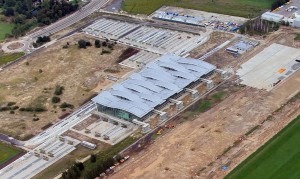
POIS.06.03.00-00-001/09-00 for the Project „Wrocław Airport – extension and modernization of airside and landside infrastructure” within the frameworks of the task 6.3 Development of air network TEN-T, priority VI Road and air network TEN-T, Operational Programme Infrastructure. The financing is defined in advance and amounts to 128 110 000,00 zł.
The object of the project is the construction of a new passengers terminal with airside and landside infrastructure which provides the increase of the capacity up to 3,3 mln passengers per year, of the airport located in TEN-T network and the capacity of Polish airspace as well as providing the high quality of services.
The Project includes the following investments:
- Construction of terminal 2, which includes:
- Construction of the technical infrastructure network connected with terminal 2,
- Construction of the airport surfaces.
Estimated total cost of the Project amounts to 381 055 359,06 zł and includes the eligible costs amounting to PLN 277 108 514,87.
TENT project

“Comprehensive study and technical documentation of development of an International Airport Wroclaw” – 2008-PL-92004-S – in the field of the trans-European transport networks (TEN-T).
The project which has been prepared by Wrocław Airport is a response to the urgent need for the diagnosis of its situation and for defining the directions of its development . At the moment, air transport is one of the most dynamically developing industries and some forecasts indicate that by 2020 there will be an increase in the number of passengers by three and a half times and in the number of air operations – by nearly two and a half times. The Project in question involves drawing up a number of documents and analyses necessary for the execution of the investment project.
The project scope encompasses the following activities:
- Preparing tender documentation
- Awarding contractors in public procurements
2.1 Laying out the master layer map
At the moment, the airport does not have a master map suitable for design purposes. Such a map is an essential element of all investment actions. Within the Project framework, we are planning to draw up such a layer map possibly including all the information necessary for potential contractors.
2.2 Laying out the GIS map
GIS is A spatial map includes geospatial information. This 3-D map containing a vector representation of the object current state, and of the network of objects, with animation at the real time of particular elements on the schemes. Designing a map in this system (in an appropriate scale) allows to present different aspects of project execution, environment protection, and so on. We wont us this map to the noise monitoring system.
2.3 Drawing up the inventory of aprons
The scope of the project actions encompasses preparation of detailed engineering design documentation of construction of taxiways, rapid exit taxiways, aprons in front of the new terminal, the South deicing apron at the threshold 29 and an isolation bay near the threshold of runway 11. Completion of this action is indispensable for the airport to further operate. Without the said project works we soon will not be able to clear aircraft for landing nor handle them as the present infrastructure has now worn out and currently remains inefficient when faced with the increasing traffic.
2.4 Carrying out the analyses of passengers and operators
This task involves comprehensive elaboration of a strategy for air service development for Copernicus Airport in Wroclaw through carrying out a number of analyses and studies regarding passengers, network of connections, trasport to and from the airport, comparisons with other airports and so on.
2.5 Drawing up technical documentation of the noise monitoring system construction
Aircraft exploitation induces noise emission around airports. The emission of noise occurs during flight operations and non-flight operations directly related to the airport functioning, and aircraft and helicopter handling. Therefore the Airport Management Board would like to take actions aimed at the construction of an acoustic screen at the apron and prepared documentation to the noise monitoring system
2.6 Making a dendrological inventory
Within the airport perimeter there are a number of trees. For safety and environmental reasons, it is necessary to classify them and draw up a detailed dendrological inventory. This will enable to identify those which constitute major flight obstacles.
2.7 Carrying out geological tests for the entire airport
The stage necessary for the project execution is carrying out geological tests. Until recently the Wroclaw airport shared the airfield with a military base. Therefore it did not and still does not have some basic documents. Carrying out geological tests for the entire airport will enable to identify the soil structure and prepare in detail the projects of construction of aprons- where soil structure and load carrying capacity are basic parameters – and all other investment projects planned to be conducted within the airport perimeter.
- External audit
The Project will be executed over the period from January 2009 to December 2011.
The Project has been divided into three major activities: Project management, implementing the project scope and external audit.
Financing:
Project management – 2009 – 50 000 e, 2010 – 30 000e
Implementing the project scope – 2009 – 2 120 000e, 2010 – 300 000e
Audit – 2010 – 20 000e
Total – 2 520 000e including cofinancing of 1 260 000e
POIS 8.4 project

POIS.08.04.00-00-001/09-01 for the Project „Improvement of safety and guards at Wrocław Airport Co.”.
Task: „Improvement of safety and guard at Wrocław Airport Co. POIS.08.04.00-00-001/09 within the frameworks of the task 8.4 Safety and guard of air transport priority VIII Safety of the transport and domestic transport networks of Operational Programme Infrastructure and Environment 2007 – 2013.”
Total cost of the Project amounts to 17 330 184,64 zł and includes the eligible costs amounting to 14 214 713, 74. Subsidy amounts to 12 082 506,67 zł. Concerns purchase of X-ray equipment for security control of hand lagguage and the articles and goods subject to security control, metal detectors and electronic system of fence protection together with CCTV system.